
prusie: SuSiE fine-mapping in Python

Statistical fine-mapping combines genetic association signals with linkage disequilibrium (LD) to prioritize candidate causal variants. prusie implements the sum of single effects (SuSiE) model in Python backed by a high-performance Rust core, enabling fast, memory-efficient Bayesian fine-mapping across regions with multiple causal signals.
prusie supports summary statistics paired with signed LD matrices (susie_rss), centered sufficient statistics (susie_suff_stat), and individual-level genotype and phenotype data (susie). Fitted models provide component-level inclusion probabilities (alpha), marginal posterior inclusion probabilities (PIPs), posterior effect moments, and credible sets. See Statistical model for the mathematical formulation and Numerical accuracy for validation against susieR 0.16.6.
Installation
prusie 0.3.1 supports CPython 3.10 and newer (standard GIL builds) and can be installed directly from PyPI:
pip install prusie
Prebuilt stable-ABI (abi3) wheels are provided for Linux (x86-64 and ARM64), macOS (Intel and Apple silicon), and Windows (x86-64), and are tested across CPython 3.10–3.15. Installing from a wheel requires neither Rust nor a C compiler, and R is never needed at runtime.
NumPy is the only required dependency for core model fitting. To enable sparse matrix inputs, extended RSS models, LD diagnostics, and plotting via SciPy and Matplotlib, install the analysis extra:
pip install 'prusie[analysis]'
See the installation guide for platform details, direct wheel downloads, and building from source.
Example
You can fit the bundled 500-variant synthetic dataset offline and inspect its retained credible sets (CS):
import prusie

example = prusie.load_example()
fit = prusie.susie_rss(**example["inputs"], **example["parameters"])
summary = prusie.summarize(fit, example["inputs"]["R"], z=example["inputs"]["z"])
print(prusie.summary_text(summary).splitlines()[0])
print(f"IBSS: {fit.convergence['stop_reason']} ({fit.niter} sweeps)")
for cs in summary["credible_sets"]:
    print(f"CS {cs['component_id']}: {', '.join(cs['members'])}")
Expected output:
500 variants; 2 retained credible sets; 2 active components.
IBSS: criterion_satisfied (3 sweeps)
CS 0: syn0100
CS 1: syn0350
Component indices are zero-based. The quick-start tutorial expands this example to explain PIPs and credible sets, generate diagnostic plots, and export an interactive offline HTML report.
Accuracy and performance
We benchmarked prusie against susieR on SuSiE-RSS fine-mapping of 200 FinnGen R13 type 2 diabetes GWAS loci and 14,157 GTEx v11 whole-blood eQTL genes. All runtime and memory speedups below report the ratio of susieR to prusie.
Measured prusie 0.3.0 against susieR 0.16.6 on the same inputs.
| Evaluated cases | Cases | Runtime ratio | Fitting-stage ratio | Median peak-memory ratio |
|---|---|---|---|---|
| GWAS | 200 | 42.9× | 48.1× | 5.11× |
| eQTL | 14,157 | 26.6× | 29.8× | 4.60× |
The runtime ratios divide the summed susieR time by the summed prusie time, using each case's median of three retained complete calls, with one numerical thread; the fitting stage excludes input and LD preparation. The memory ratio is the median of paired susieR/prusie ratios of peak backend-process memory. All measurements are from exclusive AMD EPYC 7742 nodes. Ratios for other traits, tissues, region sizes and LD references may differ; see performance.
See Performance for the benchmarking protocol and scaling experiments, and Numerical accuracy for posterior consistency across all evaluated datasets.
Sensitivity and refinement
Because IBSS optimizes the variational objective sequentially, a fit can occasionally converge to a local optimum. The toy example based on the susieR FinemappingConvergence dataset illustrates how credible-set refinement escapes a local mode to reach a higher evidence lower bound (ELBO), replacing two suboptimal singleton credible sets while preserving an unresolved high-LD pair.
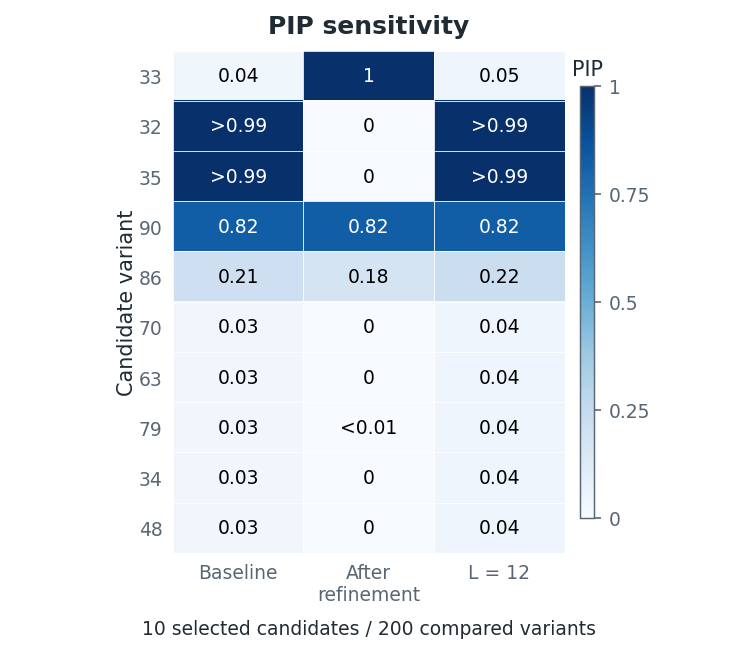
In contrast, simply increasing the number of components L from 10 to 12 leaves the baseline credible sets unchanged. You can explore the generated HTML report for this dataset to see the locus overview, per-component LD panels, and refinement history.
Documentation
- Inputs, alignment and priors: data formats, allele alignment, variant filtering, and prior specifications.
- Statistical model: SuSiE formulation, IBSS updates, summary-statistic reconstruction, and model extensions.
- Python API: entry points, shared fitting options, result objects, post-analysis helpers, and plotting functions.
- Convergence and refinement: convergence diagnostics, fit continuation, and credible-set refinement.
- Sensitivity and LD diagnostics: comparing alternative model settings and checking -score/LD consistency.
- Reproducibility: benchmark protocols, data provenance, and regenerating manuscript tables and figures.
Citation and license
If you use prusie, please cite Wang et al. (2020) for the SuSiE model and Zou et al. (2022) for SuSiE-RSS, together with the installed package version (prusie.__version__). Machine-readable citation metadata are available in CITATION.cff.
prusie is developed and maintained by Wenxin Jiang. Copyright © 2026 Wenxin Jiang. Released under the GPL-3.0-or-later license; see third-party notices for upstream attributions.