
On this page
Performance
We benchmarked the runtime and peak memory usage of SuSiE-RSS fine-mapping in prusie 0.3.0 against susieR 0.16.6 across 200 FinnGen R13 type 2 diabetes GWAS loci and 14,157 GTEx v11 whole-blood eQTL genes. All primary evaluations ran single-threaded on exclusive AMD EPYC 7742 nodes with identical inputs and model settings.
Measured prusie 0.3.0 against susieR 0.16.6 on the same inputs.
| Evaluated cases | Cases | Runtime ratio | Fitting-stage ratio | Median peak-memory ratio |
|---|---|---|---|---|
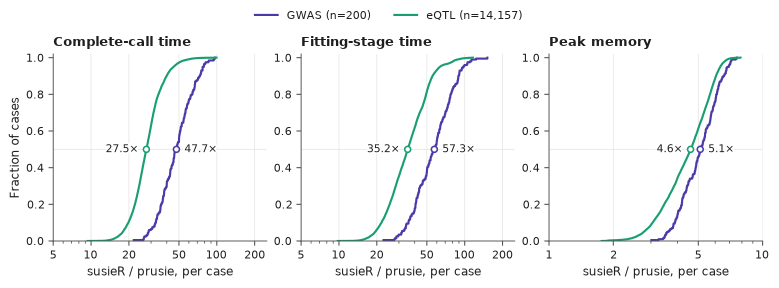
| GWAS | 200 | 42.9× | 48.1× | 5.11× |
| eQTL | 14,157 | 26.6× | 29.8× | 4.60× |
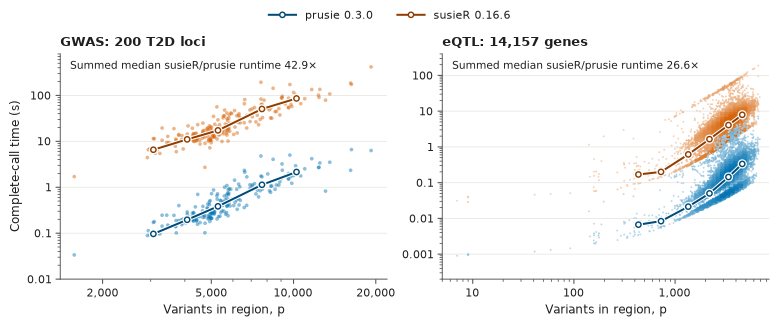
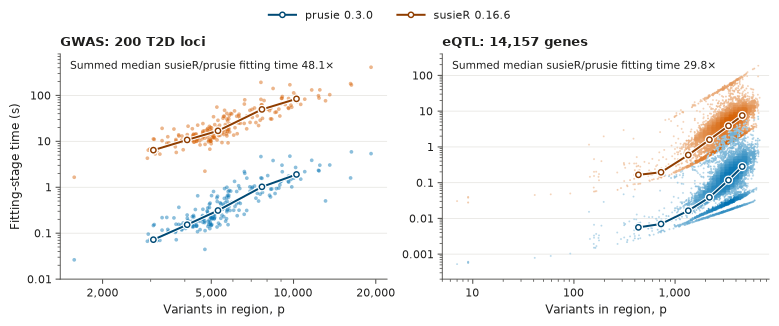
The runtime ratios divide the summed susieR time by the summed prusie time, using each case's median of three retained complete calls, with one numerical thread; the fitting stage excludes input and LD preparation. The memory ratio is the median of paired susieR/prusie ratios of peak backend-process memory. All measurements are from exclusive AMD EPYC 7742 nodes. Ratios for other traits, tissues, region sizes and LD references may differ; see performance.
The benchmark protocol and the Reproducibility section document the timing boundaries and binary digests, while Numerical accuracy reports posterior consistency on the complete alpha matrix.
Data
The fixed panel contains 200 FinnGen R13 type 2 diabetes GWAS loci (n = 486,019; 89,727 cases and 396,292 controls) and 14,157 GTEx v11 Whole_Blood genes (n = 800). GWAS is fitted with the Gaussian RSS approximation. Every case is included, including iteration-limit fits and cases with no credible set. Gene windows and study participants overlap, so cases are not independent biological replicates.
| Analysis | Cases | Variants per case | Cases where neither program converged |
|---|---|---|---|
| GWAS | 200 | 1,575 to 19,221 | 0 |
| eQTL | 14,157 | 7 to 6,862 | 224 |
For each analysis, prusie and susieR received identical aligned summary statistics, variant ordering, and signed LD matrices computed from 1000 Genomes GRCh38 reference panels: 99 Finnish (FIN) individuals for FinnGen T2D and 525 European (EUR) individuals for GTEx whole blood (see Real GWAS and eQTL inputs for harmonization details).
Methods
We recorded two complementary execution timers for each analysis:
- Complete-call time encloses the public
susie_rsscall from in-memory input arrays to returned posterior and credible-set results, including input validation, RSS scaling, IBSS iterations, and credible-set construction. - Fitting-stage time is recorded inside the same calls and isolates solver initialization, IBSS/SER updates, ELBO and convergence evaluation, and final posterior and credible-set assembly (excluding initial input validation and LD symmetrization).
Module imports, disk I/O, LD matrix computation, and result serialization are excluded from both timers. Both packages were built with lightweight timing instrumentation; on an 8-case qualification check, the instrumented binaries produced bitwise-identical alpha and pip arrays and identical iteration and credible-set counts to the uninstrumented release builds (see Benchmark protocol).
Each locus or gene was benchmarked in a fresh process per backend, executing one untimed warm-up call followed by three timed calls (n_threads=1, overwrite_ld=False). For each case, both backends ran sequentially on the same pinned physical core (in its own isolated L3 cache domain with sibling SMT threads idle and memory bound to the local NUMA node) in a randomized, balanced execution order. Inputs were staged to node-local storage, and signed LD matrices were recomputed with single-threaded PLINK before each case, outside both timers (matching precomputed reference matrices within across a 24-case audit).
We summarize runtime performance using three metrics:
- Summed-median speedup (primary): For each implementation, we take the median across the three timed calls per case, sum those medians across the dataset, and divide the
susieRtotal by theprusietotal. - All-call cumulative speedup: The sum of all retained
susieRcalls divided by the sum of all retainedprusiecalls. - Per-case speedup distribution: The median and interquartile range (IQR) of the paired per-case
susieR/prusiemedian ratios.
Peak memory was recorded at the process level after the final call (VmHWM for R and ru_maxrss for Python), capturing the interpreter, loaded inputs, warm-up, and three timed calls. Memory ratios report the median of paired per-case susieR/prusie peak RSS ratios.
All fits used L=10 (capped at ), tol=0.001, max_iter=100, scaled_prior_variance=0.2, estimate_prior_variance=True (estimate_prior_method="optim"), fixed residual variance (estimate_residual_variance=False), uniform variant priors, null_weight=0, standardize=True, coverage=0.95, min_abs_corr=0.5, the Wald RSS adjustment, ELBO stopping, check_prior=True, check_input=False, and refine=False.
Results
Runtime
| Analysis | Metric | Summed-median susieR/prusie ratio | All-call cumulative ratio | Per-case ratio, median [IQR] | prusie total | susieR total | Cases faster with prusie |
|---|---|---|---|---|---|---|---|
| GWAS | Complete call | 42.9× | 49.2× | 47.7× [38.0-58.8] | 2.7 min | 1.91 h | 200 / 200 |
| GWAS | Fitting stage | 48.1× | 55.4× | 57.3× [42.4-74.5] | 2.3 min | 1.86 h | 200 / 200 |
| eQTL | Complete call | 26.6× | 26.6× | 27.5× [23.3-32.6] | 48.0 min | 21.28 h | 14,157 / 14,157 |
| eQTL | Fitting stage | 29.8× | 29.8× | 35.2× [26.9-47.0] | 41.1 min | 20.39 h | 14,157 / 14,157 |
prusie was faster than susieR in every single GWAS locus (200/200) and eQTL gene (14,157/14,157), reducing cumulative single-threaded computation time from 1.91 hours to 2.7 minutes on the FinnGen GWAS panel and from 21.28 hours to 48.0 minutes on the GTEx eQTL panel (see Reproducibility for full per-call records).
| Analysis | Backend | Median repeat IQR/median | Cases with a call >2× its case median | Share of total time in those calls |
|---|---|---|---|---|
| GWAS | prusie | 0.0128 | 0 | 0% |
| GWAS | susieR | 0.00668 | 2 | 15.2% |
| eQTL | prusie | 0.0231 | 0 | 0% |
| eQTL | susieR | 0.021 | 0 | 0% |
Running on exclusive, core-pinned nodes kept within-case repeat variability (IQR / median) around 1–2%. Two individual susieR GWAS calls experienced runtime spikes exceeding twice their case medians (accounting for 15.2% of total susieR GWAS time across all repeats; archived in extreme_retained_calls.json). Using three-call medians per case insulates the primary 42.9× speedup from those two outliers (replacing them with their case medians lowers the all-call cumulative GWAS ratio from 49.2× to 43.0×).
Memory
| Analysis | Backend | Peak RSS, median across cases (MiB) | Cases |
|---|---|---|---|
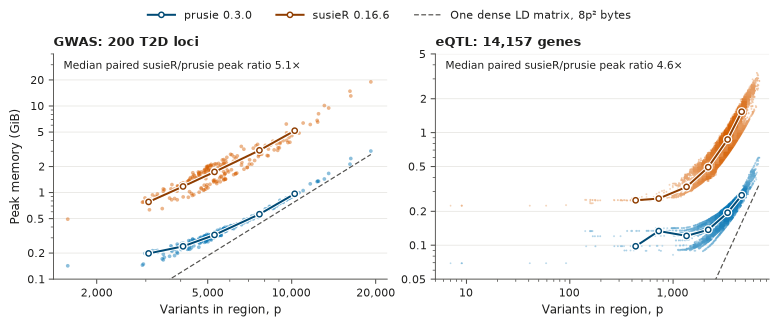
| GWAS | prusie | 335 | 200 |
| GWAS | susieR | 1.79e+03 | 200 |
| eQTL | prusie | 198 | 14,157 |
| eQTL | susieR | 880 | 14,157 |
As region size increases, prusie's peak memory approaches the theoretical footprint of a single dense float64 LD matrix ( bytes), whereas susieR allocates several additional full-size working matrices during input preparation and standardization.
Thread scaling
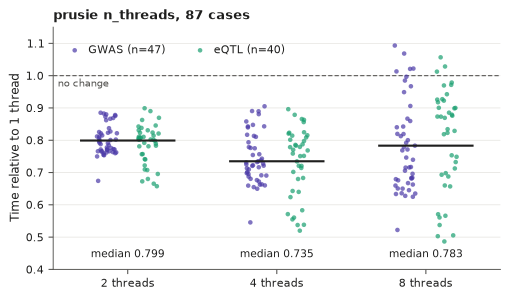
To evaluate per-fit multithreading, we benchmarked 87 real-data cases with n_threads set to 1, 2, 4, and 8 across eight paired rounds on the same exclusive nodes. Speedups are reported as the median ratio of multithreaded runtime to single-threaded runtime (values below 1.0 indicate faster execution):
| Threads | Median time / one-thread time | Faster / tied / slower, out of 87 |
|---|---|---|
| 2 | 0.799 | 87 / 0 / 0 |
| 4 | 0.735 | 87 / 0 / 0 |
| 8 | 0.783 | 79 / 0 / 8 |
Four threads achieved the lowest median runtime ratio (0.735, or a 1.36× speedup), accelerating all 87 cases. Increasing to eight threads added synchronization overhead that made 52 of 87 cases slower than with four threads; see Threads for recommendations on configuring n_threads.
LD overwrite
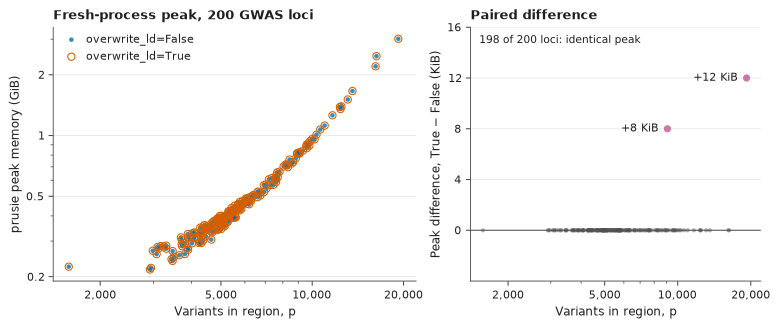
Setting overwrite_ld=True allows prusie to repair asymmetric LD matrices in place rather than allocating a separate repair buffer. We compared overwrite_ld=False and overwrite_ld=True across all 200 GWAS loci in fresh processes:
| Loci | Equal peaks | Lower with overwrite | Higher with overwrite | Largest gap |
|---|---|---|---|---|
| 200 | 198 | 0 | 2 | 12 KiB |
Because the PLINK-reconstructed LD matrices in this benchmark are already exactly symmetric, the default overwrite_ld=False path reuses the caller's C-contiguous float64 array directly without allocating a repair buffer, resulting in identical memory peaks across 198 of 200 loci and identical final alpha arrays. In-place overwriting provides memory savings primarily when external LD files contain floating-point rounding asymmetries that trigger symmetrization; see Optional LD workspace.
Nested locus windows
To illustrate runtime and memory scaling across region sizes within a single genomic region, we fitted the first 500, 1,000, 2,000, 4,000, 10,000, and all 19,221 variants of the largest FinnGen T2D locus using the settings described in Methods:
| Leading variants | Backend | Complete-call median (s) | Fitting-stage median (s) | Iterations | Peak RSS (MiB) |
|---|---|---|---|---|---|
| 500 | prusie | 0.0105 | 0.00966 | 14 | 132 |
| 500 | susieR | 0.463 | 0.46 | 14 | 285 |
| 1,000 | prusie | 0.0231 | 0.0206 | 15 | 132 |
| 1,000 | susieR | 1.29 | 1.28 | 15 | 354 |
| 2,000 | prusie | 0.0403 | 0.0298 | 5 | 147 |
| 2,000 | susieR | 1.26 | 1.22 | 5 | 505 |
| 4,000 | prusie | 0.169 | 0.127 | 11 | 251 |
| 4,000 | susieR | 10.2 | 9.94 | 11 | 1.33e+03 |
| 10,000 | prusie | 1.02 | 0.795 | 17 | 915 |
| 10,000 | susieR | 59.3 | 58 | 17 | 5.43e+03 |
| 19,221 | prusie | 5.84 | 4.92 | 28 | 3.09e+03 |
| 19,221 | susieR | 415 | 408 | 28 | 1.94e+04 |
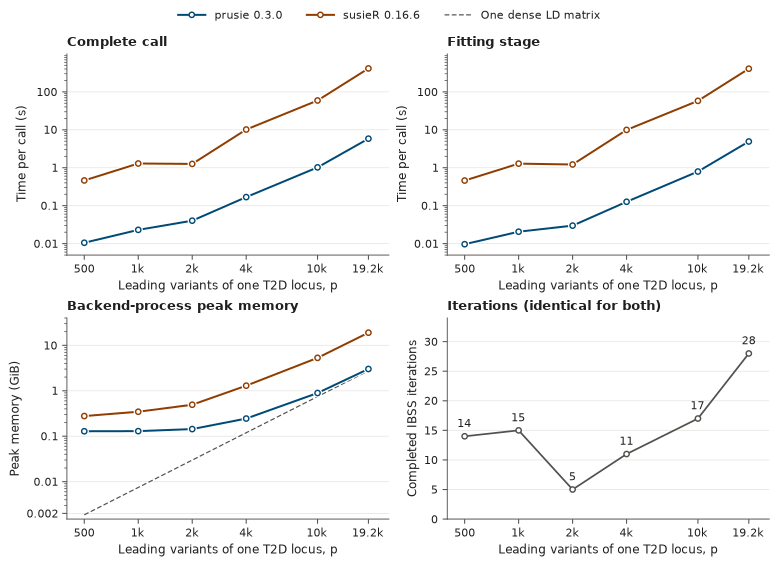
Note that the number of IBSS iterations varies with window size (for instance, the 2,000-variant window converges in 5 sweeps compared to 15 sweeps at 1,000 variants). At 10,000 variants, the reported susieR values come from a dedicated 10-call replay on the same node and core after an initial call stalled outside the solver (documented in window10000_retime.json).
Reproducibility
- Release code:
6d60d5e5723461c3e1fc5a46fd0a0e7b6378cfa7 - Release wheel SHA-256:
85285c26c1f6ae3caaed99c4d7766ede7f0083ea98eb2d26b7763d8654840b59 - Release native extension SHA-256:
a9d377e45583b654ddfbe8323a783e32a61bf042c755cb26c3873f2065ed0b3e - Benchmark protocol SHA-256:
3893ec7f92fc042f15eade88a4c27a452835bf3285dfda037d6133c55fc56825(hash of the protocol file as executed; the published copy was later edited only to remove host names, so its bytes differ) - Statistical reference: R 4.4.0; susieR 0.16.6,
8e56a8e038e989856d106d9ca5175cc664fea9d2.
Both runtime metrics use timing-instrumented copies of these release artifacts; the instrumented native binary is not byte-identical to the release wheel. The patch, derived binary hashes and timing boundaries are in the measurement archive.
All benchmark summaries and per-call timing, memory, convergence, and accuracy records are archived in benchmark_summary.json and benchmark_records.jsonl.gz (with supplementary experiments in benchmark_overwrite_records.jsonl.gz and thread_scaling.json). See the protocol file, Benchmark protocol guide, Methods, and Real GWAS and eQTL inputs in prusie-analysis for full details.
The rendered figures and compact documentation_summary.json are bundled with this repository and can be verified from a source checkout via:
python tools/generate_results.py --check