traceCB
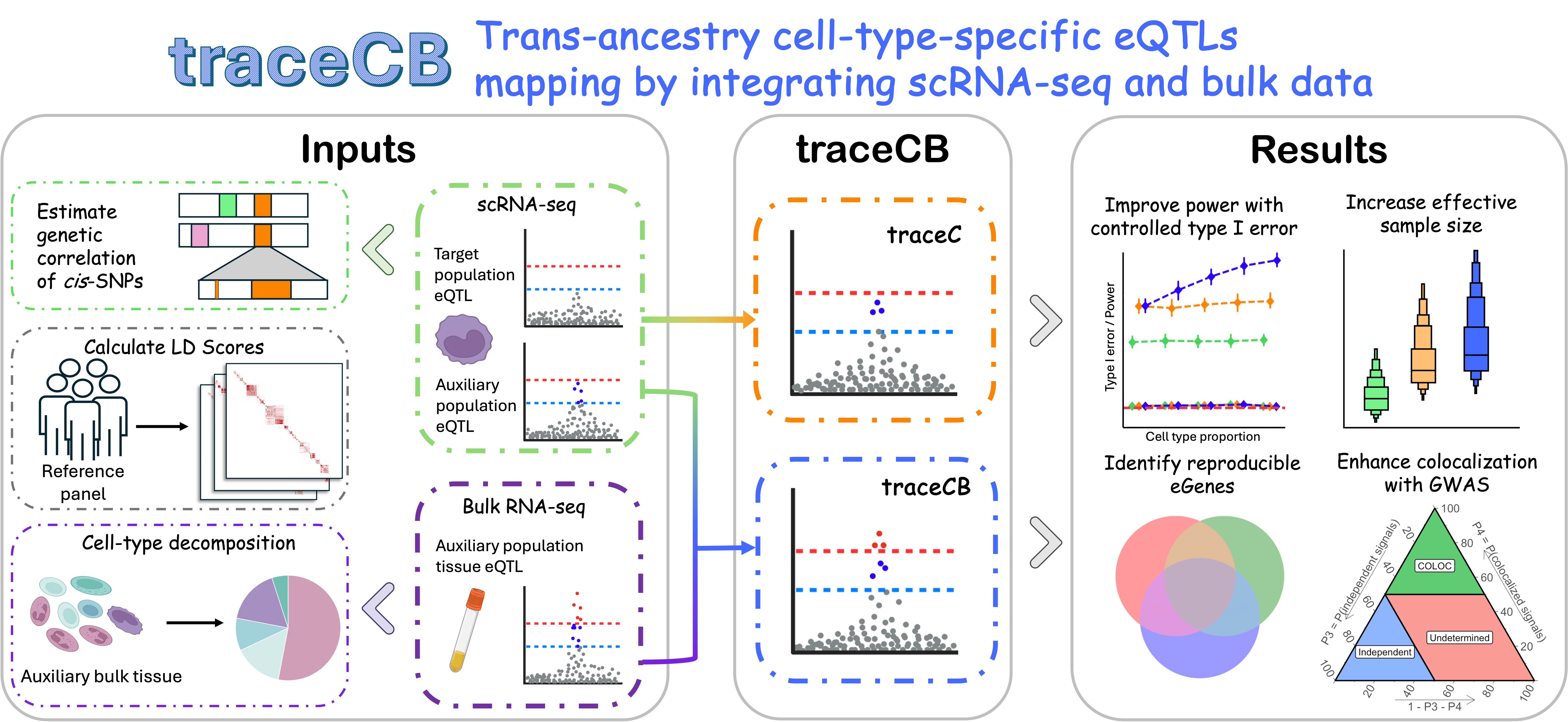
traceCB maps trans-ancestry cell-type-specific eQTL effects by integrating single-cell and bulk-tissue summary statistics. This documentation covers the installable Python package, full-data workflow, tutorial, simulations, and manuscript analyses distributed with the repository.
Key Capabilities
traceCB enables researchers to:
- Integrate single-cell and bulk eQTL data for trans-ancestry ct-eQTL mapping
- Estimate effects efficiently with a generalized method-of-moments model
- Increase discovery power while maintaining type I error control
Features
-
Integration --- Combines cell-type eQTL summary statistics with bulk-tissue information.
-
Trans-ancestry --- Shares information across populations to improve cell-type eQTL estimation.
-
Efficiency --- Optimized numerical kernels using
numbasupport large datasets.
Getting Started
Installation
Python 3.10 or newer is required. The repository is developed and tested with
the Python 3.12 reference environment in environment.yml.
git clone https://github.com/lucajiang/traceCB.git
cd traceCB
conda env create -f environment.yml
conda activate py312
For a library-only installation, use pip install -e . in an existing
supported Python environment.
In a lightweight or custom environment, install .[tutorial] to run the local
notebook, or .[enrichment,figures] for the manuscript analysis scripts.
Repository organization
src/traceCB/: installable model implementation.scripts/: preprocessing, LD-score, GMM, and colocalization entry points.src/preprocess/andsrc/coloc/: workflow implementations.src/simulation/: main, supplementary, and chromosome 22 simulations.src/enrichment/: S-LDSC and pathway-enrichment analyses.src/figures/: manuscript figure scripts.
Guides
Explore our documentation to learn how to use traceCB:
- Path configuration — machine-specific settings, input layouts, and checks before running.
- Pipeline workflow — input sources, formats, preprocessing, and full-data execution.
- API reference — core model functions.
- Tutorial — local and Google Colab walkthroughs.
- Simulation guide — manuscript simulation entry points.
- Enrichment guide — S-LDSC and pathway analyses.
Citation
Jiang W, Xiao J, Cai M. traceCB: Trans-ancestry cell-type-specific eQTLs mapping by integrating scRNA-seq and bulk data. bioRxiv. 2026. doi:10.64898/2026.06.20.733502.
Support
For any questions or issues, please contact wx.jiang@my.cityu.edu.hk or open an issue on GitHub.